
Local governments, as the closest tier to the public, are vital to American democracy. Yet in an era of fragmented media and declining institutional trust, local officials often struggle to convey the importance and the value-for-money of the public services they provide. This struggle includes how they inform their constituents how revenues are raised, spent, and what services they deliver.
In most local governments, the budget is presented to the public in a way that is inaccessible to most constituents, who often lack in-depth knowledge of budget processes or related technical expertise. While local governments may share some budget information, they seldom present the budget information in a way that provides insights for their constituents. The often overly technical presentation of local budget plans can reduce trust in government and limits meaningful citizen engagement in the budget process.
Perhaps surprisingly, comparatively poor public communication and relatively weak citizen engagement is systemic in the U.S., with the National Civic League advocating for more resident-focused local governance across the country. For instance, despite its transparent and award-winning budget formulation process, even Fairfax County, Virginia—Virginia’s most populous county—appears to face challenges communicating the content of its budget with its constituents. Yet, examples of more inclusive and effective citizen-centric budget communications can be found both near and far, from Loudoun County, Virginia, to Helsinki, Finland, and other parts of the world.
Citizen engagement starts with informed citizens
In practice, local governments around the U.S. differ considerably in the degree and manner in which they engage citizens in public decision-making. While public participation mechanisms are common—including public hearings, community meetings, citizen academies, and advisory bodies—many engagement processes assume that residents already possess the background knowledge needed to participate meaningfully. This challenge is especially visible in local government budgeting.
Most local governments in the United States formally invite citizen input into annual budget decisions. However, participation often occurs after release of lengthy and technical budget documents that were prepared primarily for elected officials, administrators, and finance professionals. As a result, citizens who lack budget expertise—or who have limited time or opportunity to acquire it—find themselves effectively excluded from meaningful participation.
These barriers tend to be especially pronounced for communities that have historically had fewer opportunities to engage with public institutions, including minority and underserved populations.
In addition, communicating budget information in a more citizen-centric manner provides value beyond the (often relatively small number of) residents who actively participate in budget hearings or civic processes. Most citizens engage with local government more passively—as voters, taxpayers, service users, and community members who rarely attend public meetings or read technical budget documents. By helping citizens better understand where public resources come from, how public services are funded, and what tradeoffs local governments face, Citizen Budgets can strengthen public understanding and improve trust in government—even among residents who do not directly participate in budget formulation.
From transparency to understanding: what is a Citizen Budget?
Traditional transparency approaches often focus on making information available. Citizen-centered governance requires a different objective: making public information understandable.
Many local governments provide residents with a “citizen’s guide to the budget” or a “budget in brief,” typically offering definitions of technical terms or explaining the budget process. While useful, these materials frequently continue to assume that citizens must adapt themselves to government budgeting practices. By contrast, a Citizen Budget starts from the opposite premise: public institutions should communicate in ways that are accessible to ordinary citizens.
By contrast, a Citizen Budget is a budget document that is accessible to citizens—local residents, taxpayers, and constituents—who are not expected to have specialized knowledge of public budgeting or public finance. Citizen budgets provide a transparent overview of the local budget proposal in a way that is understandable and engaging for ordinary citizens—by making use of graphs, simplified formats, or interactive tools—thereby enabling and encouraging greater public participation in budget discussions.
Enhancing trust in government and ensuring effective public participation and citizen engagement requires that local governments move from providing data and information to their citizens to providing insights about local budgets, finances, and performance.
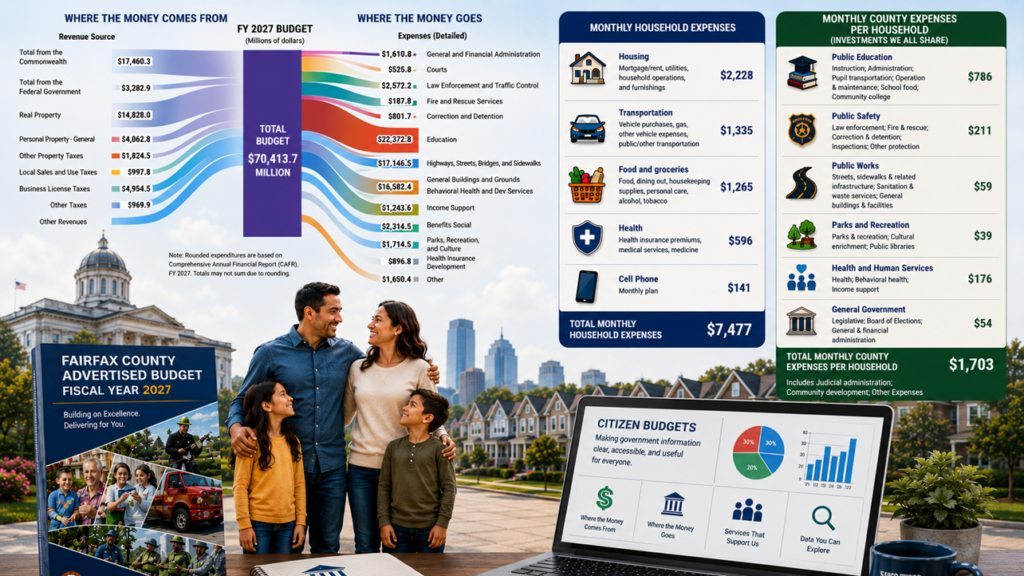
One specific way to make local government finances more relatable is to recognize that households plan, budget, and spend on a monthly or per-unit basis: households think about what they spend each month on housing, transportation, food, health care, and everyday services. Likewise, one of the ways to convey local government finance data more clearly and understandably is by expressing public spending in amounts per household, per month, rather than only in (or in addition to) millions or billions of dollars.
For instance, to the average citizen, it may be more meaningful to say that households collectively benefit from roughly 61 dollars per month in local law enforcement services—which is part of 173 dollars per month in public safety spending—than to say that local governments in Virginia spend 7 billion dollars annually on policing and public protection. Likewise, while it sounds like a large amount when Fairfax County spends 193 million dollars each year on parks, recreation, and libraries, residents may find it easier to relate to the idea that this translates into only ten dollars per household per month for library services or 27 dollars per household per month for parks—often less than the cost of many common household subscriptions. Presenting local government finances in these more relatable terms can help residents better understand the value and breadth of public services that local governments provide.
When a coordinated and collaborative approach is taken, and when AI tools are effectively leveraged, presenting local government budgets in a citizen-centric manner should be doable for even the smallest of local governments. While a state-wide local finance portal could provide accessible budget information for all local governments in a state, current efforts often provide raw local finance data rather than insights. An online “civic observatory” could transform available data into insights at scale, allowing citizens direct access to analytic insights, while at the same time facilitating local governments’ efforts to produce more effective budget documentation.
Why public budgets are difficult for citizens to understand
Public budgets are among the most important policy documents governments produce, but they are rarely designed with citizens in mind. Several factors contribute to this challenge.
First, local budget documents are typically designed first and foremost as decision-making and management tools for elected officials, executives, department leaders, budget professionals, auditors, and oversight bodies—not as communication tools for ordinary citizens. As a result, budget documents are often extremely long and highly technical. Citizens reasonably expect public officials to manage complexity on their behalf and may not wish—or be able—to navigate hundreds of pages of financial tables.
Second, as already noted above, budgets are frequently expressed in millions or billions of dollars, making it difficult for residents to relate spending decisions to their own experiences. Presenting information per household, per resident, or in terms of everyday public services can make government finances more understandable.
Third, citizens—local voters and taxpayers—often underestimate both the breadth and complexity of local government responsibilities or overlook how many public services depend on local spending. Unlike many household purchases, local taxes—especially highly visible and relatively “lumpy” taxes such as the annual property tax bill—are expected to finance dozens of different functions at once: public schools, policing and emergency response, parks and libraries, roads and transportation, land-use planning, building permits, and local administration, among many others. Without visibility into the full portfolio of local services provided, taxpayers may focus primarily on the size of the local budget rather than the range of infrastructure and services that it supports. Citizen-centered budget communication can help place public expenditures—including administrative and staffing costs—in context and strengthen understanding of the public value being delivered.
Fourth, unlike local taxes—which tend to be highly visible and directly felt by local taxpayers—intergovernmental fiscal flows are often invisible. Citizens may not realize how local services are financed through combinations of local taxes, state support, federal resources, and shared responsibilities. As a result, residents in some communities may underestimate the extent to which their local services depend on external funding, while residents elsewhere may overestimate the local tax burden required to sustain public services. A well-designed Citizen Budget can help make these intergovernmental connections visible by showing not only where local revenues come from, but also which level of government pays for which services and how resources flow across levels of government to support outcomes that citizens experience locally.
Finally, traditional local media once played an important role in translating public decisions into accessible narratives. Today, fragmented media environments and increasing reliance on social media place greater responsibility on public institutions to communicate clearly, accurately, and credibly. When public information is difficult to understand, confusion and mistrust can grow—and public institutions become more vulnerable to misunderstanding, misinformation, and politicized narratives.
Citizen budgets within the spectrum of citizen participation
Public participation and citizen engagement can be understood as existing along a spectrum: from informing citizens, to consulting them, to involving them directly in decision-making and collaborative governance. Citizen Budgets are not intended to replace public participation or citizen engagement —in fact, Citizen Budgets intend to strengthen these processes.
Different communities may pursue different levels of participation depending on local preferences, resources, and institutional culture (see Figure). Some communities may prefer representative decision-making with limited direct participation, while others may pursue more collaborative approaches. Regardless of where a locality sits on this spectrum, informed participation remains essential.
| Figure. The spectrum of community engagement to ownership |
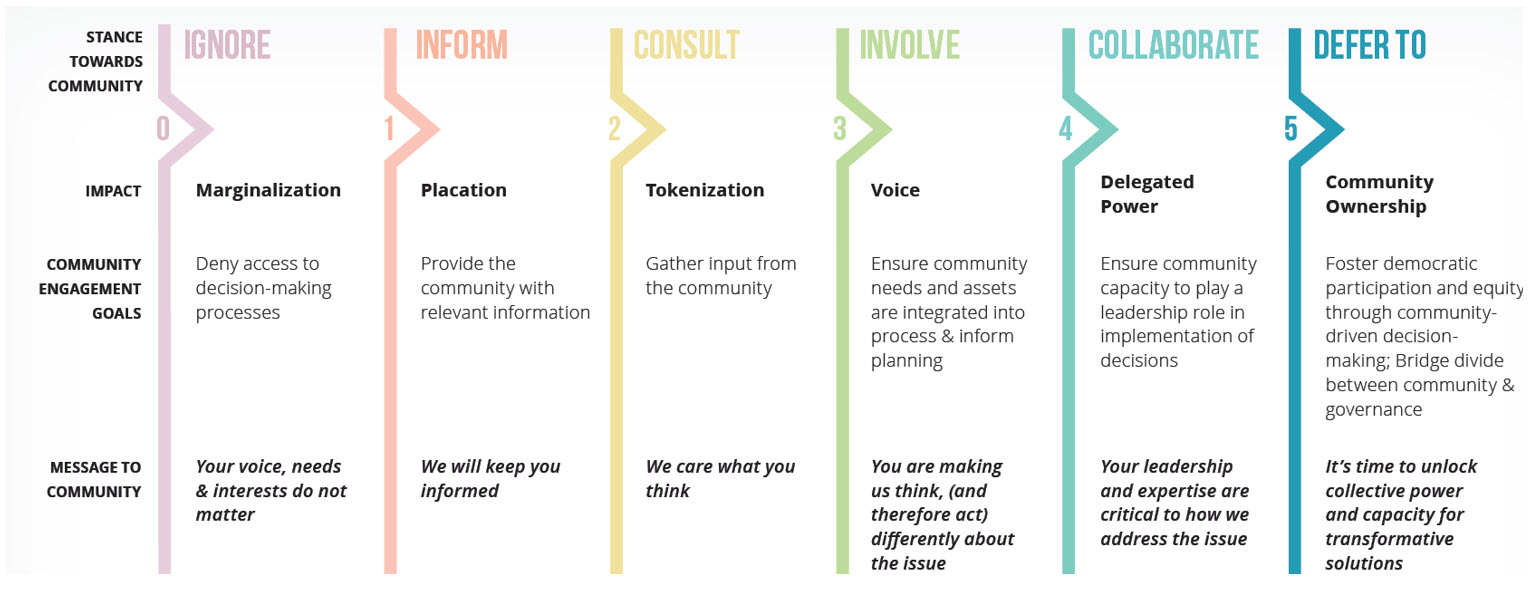 Source: Rosa González. The Spectrum of Community Engagement to Ownership |
Citizen Budgets operate primarily within the inform and consult stages of participation by ensuring that residents understand the issues before being asked to provide input. In communities pursuing more participatory or collaborative approaches, accessible budget information becomes an important foundation for deeper engagement. Regardless of the extent and nature of public participation in the local budget process, Citizen Budgets therefore represent a practical and scalable step toward greater transparency, more informed civic participation, and more responsive government.
Examples of effective citizen-centered local budget communication
Citizen Budgets and related constituent-facing budget communication approaches are increasingly used around the world to make public finances more understandable and to encourage more meaningful citizen engagement. Examples of effective citizen-centered budget communication can be found both close to home and around the world.
In Virginia, Loudoun County’s Budget Story is an annual, resident-focused companion piece to the adopted financial plan that illustrates how taxpayer dollars fund county programs, staff, and capital projects. The document presents budget information through a more narrative and visual format than traditional budget documents and spotlights some of the ways the county puts tax dollars to work, helping residents connect revenues and expenditures to services and policy choices.
A somewhat different example comes from Washington, DC, where the DC Fiscal Policy Institute (DCFPI) annually prepares a constituent-facing Resident’s Guide to the DC Budget, which translates the District’s proposed budget into more accessible explanations of spending priorities, revenue choices, and their implications for residents. Rather than reproducing official budget tables—or limiting itself to providing a glossary of budget terminology—the guide seeks to provide additional context that helps readers interpret what the budget means in practice, including how resources are allocated, how public services may be affected, and what policy tradeoffs are involved. This example also illustrates that constituent-facing budget communication need not always be prepared by governments themselves; civil society organizations, think tanks, and other policy intermediaries can also play a complementary role in making public finances more understandable and supporting more informed public discussion.
In the United States, the Government Finance Officers Association (GFOA) promotes the preparation of so-called Popular Annual Financial Reports (PAFRs) as a way to present financial information in a more accessible format for residents. PAFRs represent an important step beyond traditional financial reporting by summarizing financial results and using visual and explanatory elements. However, because they are generally derived from Annual Comprehensive Financial Reports (ACFRs), they often remain focused on financial and accounting information and may place less emphasis on connecting public spending to services delivered, operational performance, and citizen priorities.
Internationally, several cities have gone further in integrating transparency, performance communication, and citizen participation. Rather than relying on a single Citizen Budget document, Helsinki (Finland) places strong emphasis on communicating public value and service delivery outcomes to residents across all of its operations. For instance, the city’s annual report organizes information around departments and services, presenting staffing and operational information, and connecting expenditures to the services delivered—often in relatable terms such as spending per resident.
Importantly, Helsinki’s approach to constituent-facing communication exists alongside a deeper participatory budgeting process rather than replacing it. Through Helsinki’s OmaStadi (“My City”) platform, residents are invited to submit ideas for improving their neighborhoods and city services, collaborate in refining proposals, and vote online for their preferred projects, which are then implemented by the city. This illustrates how accessible public communication and more direct forms of citizen participation can reinforce one another: citizens are first provided with context and information about how government works and then given opportunities to shape future spending priorities directly.
Other European cities—including Amsterdam, Paris, and Barcelona—have developed constituent-facing budget and financial communication approaches that likewise place considerable emphasis on accessibility, visual presentation, and public understanding than more traditional budget documents. Rather than focusing primarily on financial compliance or accounting categories, these cities increasingly organize information around policy priorities, municipal services, neighborhood investments, and quality-of-life outcomes. While their specific formats differ, these approaches tend to present public finances through (static or interactive) visualizations, concise narratives, and service-oriented explanations that connect public spending to everyday resident experiences. To a greater or less extent in each of these cities, budget communication is integrated with broader transparency and participatory budgeting efforts, allowing residents not only to see how resources are allocated, but also to better understand the tradeoffs involved in public decision-making and the results that government seeks to achieve.
The push towards citizen-centered budget communication is not limited to Europe. For instance, Porto Alegre in Brazil—widely recognized as one of the pioneering global examples of participatory budgeting—demonstrated how accessible budget information and structured citizen engagement can empower residents to directly influence local spending priorities and strengthen public trust in local government. More recently, Jakarta (Indonesia) has developed Jakarta SMART APBD (Smart Budget), an interactive public budget platform designed to make the city’s budget more transparent and accessible to residents. Rather than publishing only formal budget documents, the portal presents budget information through integrated data, visualizations, explanatory materials, infographics, news updates, and supporting content intended to help users explore and better understand the city’s budget and budget preparation process. While the Jakarta platform remains primarily a transparency and information tool rather than a full participatory budgeting process, it illustrates how digital approaches can help move public communication beyond the publication of technical documents in a large and complex urban government.
While these examples differ in format and ambition, they illustrate a common principle: effective public transparency is not simply about publishing information—it is about presenting public information in ways that help citizens understand, interpret, and engage with government decisions.
Looking ahead: innovation in citizen-centered public communication
Advances in public data availability, digital tools, and emerging analytical capabilities create opportunities to rethink how governments communicate with citizens. Citizen Budgets represent one example of a broader shift from publishing information to generating insight. Rather than asking citizens to become public finance experts, governments can increasingly present evidence and performance information in forms that connect public resources to services, outcomes, and lived experiences.
Preferably, local governments themselves should prepare and present Citizen Budgets and related constituent-facing information products. While doing so requires time, analytical effort, and communication capacity, local leaders should view this investment as being in their own long-term interest. Clear and accessible communication helps residents understand not only how public resources are being spent, but also the value-for-money that local governments deliver through public services, infrastructure, and community outcomes. Stronger communication can support greater public understanding, more constructive public engagement, and stronger trust between institutions and residents.
At the same time, not all local governments—or local leaders—place equal value on public engagement or invest equally in citizen-centered communication. In some cases, public information may remain technically available but practically inaccessible to ordinary residents. In such circumstances, there may be an important role for civil society organizations, public policy institutions, universities, and other civic actors to help “prime the pump” by preparing accessible analyses and demonstrating alternative approaches. These efforts can help create demand for more meaningful public communication while illustrating that transparency is most effective when public information is translated into insights that citizens can understand and use.